
News
Most print and apply labeling systems use white labels because industrial printing commonly relies on thermal transfer technology, where a ribbon works together with the label material to complete printing. White labels provide stable print performance and good information readability, and they have been widely validated through long-term industrial use, making them the standard choice for logistics, warehousing, and manufacturing applications.
Why Are White Labels the Industry Standard?
Better Fit for Thermal Transfer Printing
Industrial print and apply systems commonly use thermal transfer printing, where heat transfers the content from the ribbon onto the label surface.
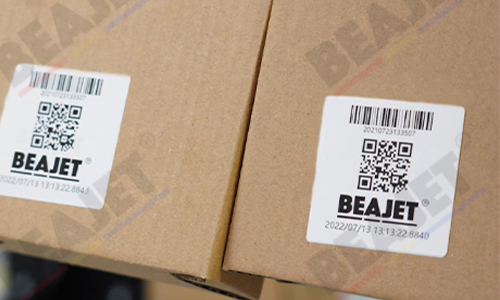
The label background affects how printed information appears. White labels provide a suitable printing surface, helping text, barcodes, and QR codes remain clear for both manual viewing and automated identification.
Suitable for Most Industrial Applications
Print and apply labeling systems are widely used for shipping labels, product labels, carton labels, pallet labels, and other industrial identification applications.
These applications require stable information presentation, reliable identification, and long-term operation, which is why white labels have become a widely adopted standard solution.
Mature Label Supply and Specifications
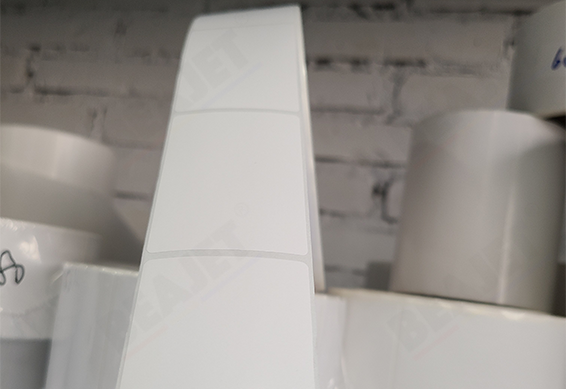
White labels have been used extensively in industrial applications and have developed a mature supply system with a wide range of sizes, materials, and specifications.
For automated production lines and warehouse logistics projects, mature label solutions help reduce selection complexity and simplify long-term management.
Why Are Colored Labels Not Commonly Used in Industrial Projects?
Industrial print and apply projects typically prioritize standard white labels to maintain consistent printing performance, information recognition, and application stability.
Colored labels involve additional considerations, such as matching the label background with printing performance, and usually require confirmation based on specific project requirements. They are not the standard solution for most automated print and apply applications.
Therefore, without specific identification requirements, companies generally prefer mature and stable white label solutions.
What Should Companies Consider When Selecting Labels?
When selecting labels for a print and apply system, companies should consider:
Label size and material;
Printing method and ribbon type;
Barcode and QR code recognition requirements;
Product packaging;
Actual labeling environment.
Label selection should be based on print performance, identification requirements, and long-term operational stability.
White labels have become the standard choice for print and apply labeling systems not because the equipment can only use white labels, but because they better meet industrial requirements for stability, readability, and standardized applications. For most logistics, warehousing, and manufacturing projects, white labels remain the more mature and reliable choice.
Hangzhou Beajet Digital Technology Co., Ltd. specializes in industrial printing and automatic print-and-apply labeling solutions, integrating equipment development, manufacturing, solution design, and technical support for logistics, intelligent manufacturing, and automated production applications.